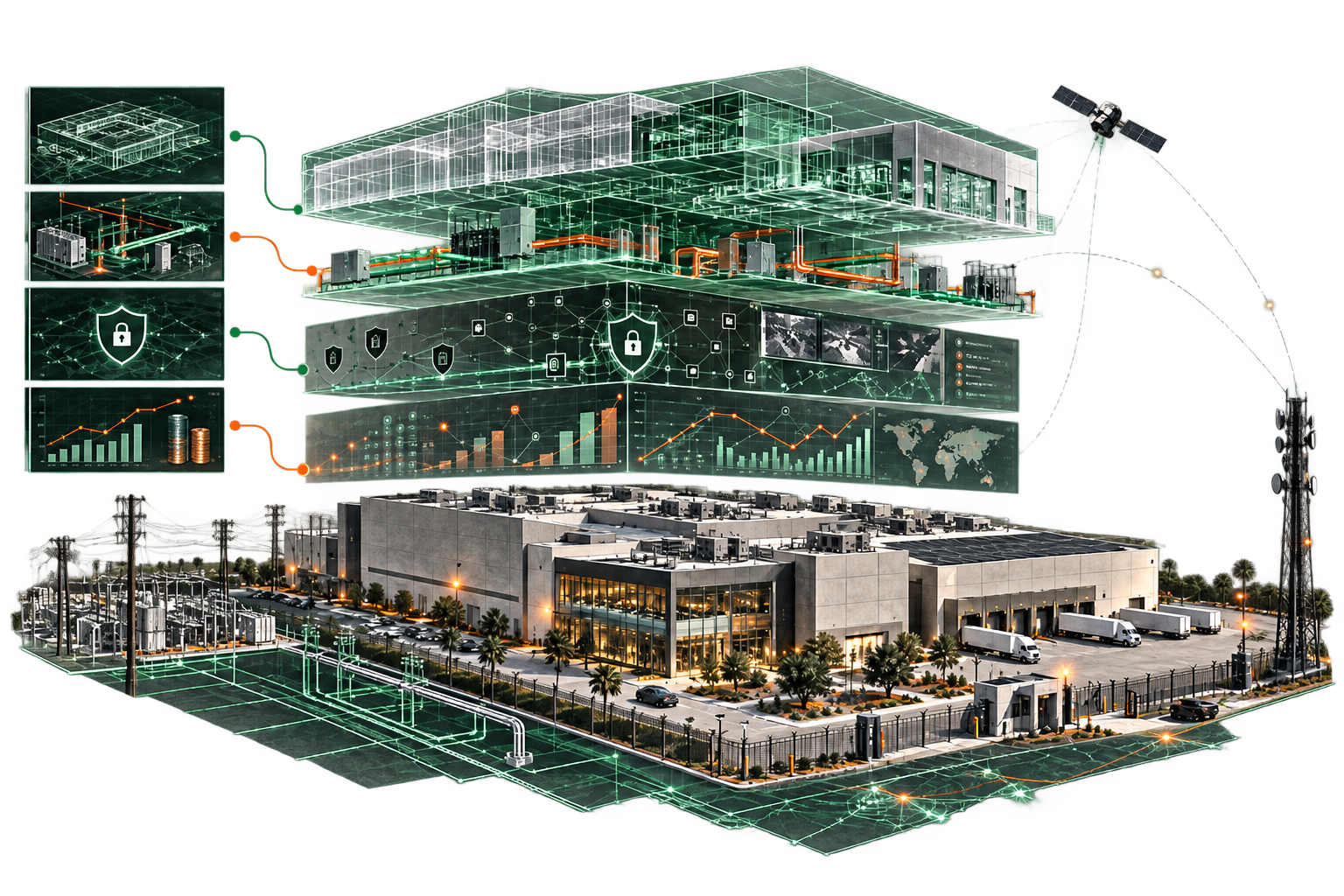
A digital-twin cutaway connects an industrial facility to utility, security and operational intelligence layers.

Mission-Ready Intelligence · ART-119

The Property Has a Digital Twin. Now Give It a Mission Twin.

A property model tells you what the asset is. A Mission Twin tells you what the asset must do next—and connects the property, utilities, trust controls and capital required to make that mission real.

1Mission statement that defines the next operating milestone.
4Connected twins: Property, Utility, Trust and Capital.
1Shared gap register with owners, dependencies and status.
Update the twins whenever the mission changes.
MissionPropertyUtilityTrustCapitalActions

01 · The simple difference

A Digital Twin describes the asset. A Mission Twin drives the decision.

The goal is not to create another 3D model. The goal is to connect the next operating requirement to the physical, infrastructure, trust and funding decisions that can make or break it.

CURRENT STATE

Property Digital Twin

A practical digital record of the asset as it exists today.

  • Building, parcel, floor area and layout
  • Utility service and physical systems
  • Existing rooms, rights and constraints
  • Current equipment and operating conditions
  • Known costs, leases and improvement history
INTENDED STATE

Mission Twin

A working model of what the property must support to reach the next customer, production, security or growth milestone.

  • What the mission requires next
  • Where the current asset falls short
  • Which twin owns each requirement
  • What must happen first
  • Who owns the action, cost and schedule

02 · Four connected twins

Four questions keep the mission honest.

Each twin owns a different part of the operating path. None should be reviewed in isolation, because one change—new equipment, a new customer, a secure program—often moves all four.

Mission Twin operating loop connecting mission, four twins, gaps, owners, cost, schedule and readiness MISSION REQUIREMENTSWhat must be true? PROPERTY + UTILITYPhysical + infrastructure TRUST + CAPITALControl + funding GAPS + OWNERS + DEPENDENCIESCost · schedule · action READY TO EXECUTE

03 · How they work together

Start with the mission. Work backward.

The Mission Twin is the operating layer above the four twins. It turns a business milestone into a sequence of requirements and makes cross-dependencies visible before they become expensive.

01
State the mission.

Example: “Install and start qualified production on a new precision cell by March.”

02
Translate it into requirements.

Space, slab, power, cooling, access, schedule, budget and controls.

03
Ask each twin what changes.

Existing capability, gap, prerequisite and owner.

04
Sequence the gaps.

Show what must happen first and which decisions can happen in parallel.

05
Update as the mission moves.

The twins remain live as equipment, schedule, customers and capital change.

04 · Mission change lab

One new requirement can move all four twins.

Pick a simple operating change. The result below shows the practical questions that immediately appear across property, utilities, trust and capital.

Selected mission change

05 · Change-the-mission simulator

Stack the changes. Watch the gap register move.

Turn on additional operating requirements. The register combines the selected mission scenario with the extra changes so the team can see the full operating path in one place.

Shared Mission Gap Register

0 active rows0 open gaps4 twins represented
Requirement Twin Current state Gap / action Owner Dependency Status

06 · What the Mission Twin produces

Not another model. A working decision set.

Each output should be usable by the person who has to make the next decision—property, operations, engineering, security, finance, lender, insurer or executive team.

OUT-01

Mission requirements

One clear statement of what must be true for the next operating milestone.

OUT-02

Property fit

What the building supports today and what physical changes are required.

OUT-03

Utility path

Required load, available service, upgrades, lead times and interim options.

OUT-04

Trust plan

Physical, digital, people and information boundaries needed for the mission.

OUT-05

Capital plan

Who funds what, when cash is required and what contingency is needed.

OUT-06

Critical path

The few dependencies that actually control the target operating date.

OUT-07

Gap register

Requirement, owner, action, dependency and current status in one shared table.

OUT-08

Readiness status

A simple answer: ready, conditionally ready, blocked or redesign the plan.

07 · Day in the life

You signed a new customer. Production must move into an existing building.

The Mission Twin prevents the team from treating the lease, utility, security and budget questions as separate projects.

MONDAY · BUSINESS

The customer milestone becomes the mission.

“First qualified units ship in six months.” That date becomes the anchor for every other twin.

TUESDAY · PROPERTY

The Property Twin tests the physical fit.

Where does the line go? Can the slab, receiving, roof, clearances and circulation support it?

WEDNESDAY · UTILITY

The Utility Twin tests the infrastructure fit.

What is the connected load? Is capacity already available? What upgrade has the longest lead time?

THURSDAY · TRUST

The Trust Twin defines the operating boundary.

Who can enter, what systems connect, how visitors are handled and which data or equipment must be separated?

FRIDAY · CAPITAL

The Capital Twin turns requirements into a funded sequence.

Owner work, tenant work, utility deposits, equipment spend, contingency and cash timing are put on one page.

NEXT WEEK · MISSION

One go / change / phase / stop decision.

The team now sees the operating path, the true critical path and the alternatives before commitments harden.

08 · Practical readiness check

Before saying “this property is ready,” answer 12 questions.

This is intentionally simple. If the team cannot answer these questions, the Mission Twin is not yet complete enough to support a confident operating decision.

09 · Bottom line

The Mission Twin explains the decision.

A property can be fully documented and still be wrong for the next mission. The Mission Twin makes the intended use explicit, shows what each connected twin must support, and turns gaps into actions before the team commits time and capital.

The Property Twin explains the asset.The Mission Twin explains what the asset must do next.

Mission-Ready · Mission Twin advisory

Turn the next operating milestone into a property-level action plan.

Email Carl for a tailored Mission Twin intelligence package connecting exact property conditions, utility capacity and timelines, secure operating requirements, capital responsibilities, and critical-path dependencies—then translating them into the decisions, owners and sequence required to move forward.

  • Exact property fit
  • Utility capacity + lead times
  • Trust + security controls
  • Capital responsibility
  • Shared gap register
Build the Mission Twin behind the decision.Email Carl About a Mission Twin

Scope can focus on one facility, a portfolio, a customer-driven expansion, a secure program, a high-power installation or another mission-critical operating decision.

Exported