M3.2
Compton-area earthquake
USGS · Sep. 6, 2026
Seismic Intelligence Brief · Southern California Hard Tech
Southern California’s hidden earthquake exposure is not just structural damage. It is production downtime, equipment failure, lifeline disruption and correlated mission loss.
Los Angeles · September 7, 2026 · Mission-Ready Intelligence
01 · By the numbers
Sunday’s event was small. The industrial system above and around Southern California’s faults is not. These figures frame the gap between a minor news event and a major correlated manufacturing catastrophe.
02 · The hidden exposure
The risk model is wrong if it stops at the building.
Traditional earthquake analysis asks whether a structure will remain standing. Hard-tech underwriting needs a second question: will the tenant still be producing?
FEMA Hazus separates earthquake loss across structural damage, nonstructural damage, contents/equipment, monetary loss and business interruption. Manufacturing/process machinery and other equipment categories can be acceleration-sensitive—meaning economic loss can begin before severe structural failure.
03 · Scenario intelligence
Switch lenses to contrast the minor September 6 event with the historic USGS ShakeOut economic scenario. Scenario values are planning estimates, not forecasts.
A minor earthquake can be uneventful. The exposure question is what changes when damaging shaking intersects a concentrated manufacturing network.
04 · One event, four catastrophes
The same physical event propagates through different systems. Each stage can become the dominant loss driver even when the previous stage appears manageable.
Shaking, liquefaction and settlement affect structure, slab, process utilities, machinery and inventory.
Most visible loss.The shell survives while calibration, equipment, environmental control or process qualification prevents production.
Most easily missed.Power, water, telecom, roads, suppliers, specialty processors and technicians determine whether production can restart.
Most correlated.BI, liquidity stress, landlord NOI, lender exposure, insured accumulation and program disruption amplify the original event.
Most consequential.05 · Interactive catastrophe chain
The useful hard-tech model is not “earthquake → building damage.” It exposes intermediate failure points so engineers, owners, tenants and insurers can see what drives functional loss.
06 · Functional recovery
A sophisticated facility runs on multiple recovery clocks. Reoccupancy is only one. Production often waits on stable utilities, calibration, process qualification and upstream suppliers.
Seconds of shaking.
Months of recovery.
A building might reopen well before its production line. That gap is where inspection cost, lost throughput, expediting, replacement lead times and business interruption accumulate.
07 · Correlated catastrophe
Ten properties can still be one catastrophe if they share the same failure drivers.
To the insurer they may appear as separate policies. To the earthquake they can behave as a correlated network.
Earthquake × Building Vulnerability = Property Loss
LOSS MODEL / HARD-TECH08 · Underwriting intelligence
Select a stakeholder. The core risk is the same earthquake; the decision metric changes depending on who owns the building, operates the factory, insures the loss or depends on the mission.
09 · Bottom line
Sunday’s M3.2 event was essentially a reminder, not a catastrophe. A damaging earthquake does not need to flatten Southern California’s advanced-manufacturing base to create severe economic loss. It only needs to stop enough production at the same time.
10 · Evidence
Figures are presented as observed/reporting facts or scenario outputs. ShakeOut values are hypothetical planning estimates—not a prediction of a specific future event.
Reporting on the September 6, 2026 earthquake and Newport–Inglewood fault context.
Open source ↗Earthquake Model Technical Manual; structural, nonstructural, contents/equipment, monetary and BI framework.
Open source ↗Space / aerospace employment and occupied industrial footprint.
Open source ↗Economic-impact analysis including property damage, direct/indirect BI and lifeline effects.
Open source ↗Hypothetical M7.8 Southern San Andreas scenario, fire and regional consequence analysis.
Open source ↗Seismic hazard mapping context, including liquefaction hazard zones.
Open source ↗SP 1254 framework distinguishing safety-oriented performance from restoration of basic intended functions.
Open source ↗Mission-Ready Intelligence · Investigative Feature
A small earthquake near Compton caused no reported damage. The harder question for Southern California’s aerospace, defense and advanced-manufacturing economy is what happens when the next damaging event leaves the buildings standing—but stops the machinery, utilities, suppliers and qualification systems inside them.
At 12:13 a.m. Sunday, the ground moved beneath southern Los Angeles County. The earthquake was small: , centered south-southeast of Compton at a depth of roughly . Residents reported feeling it across the region. No significant damage or injuries were reported.
The event mattered less for what it did than for where it happened. Reporting placed the epicenter over the , the urban fault system associated with the destructive .
There is no evidence in the event itself that a larger earthquake is imminent. Small earthquakes should not be treated as countdown clocks. But the geography creates a useful counterfactual: what if materially stronger shaking crossed the same industrial economy?
The industrial geography above Southern California’s fault systems has changed dramatically since 1933. Los Angeles County reported roughly in aerospace product and parts manufacturing as of December 2024. Long Beach reports more than occupied by its space and aerospace industry and more than active in space and aerospace design, engineering and advanced manufacturing.
Those figures represent only part of the regional system. The wider Southern California economy includes precision machine shops, electronics manufacturers, robotics companies, space-hardware producers, optical systems firms, specialty processors, test laboratories and advanced-material operations. Their real-estate footprints can look ordinary. Their operational tolerances often are not.
That concentration changes the unit of earthquake analysis. A damaging event is not only a property-loss problem. It can become a manufacturing interruption, then a supplier interruption, and—where a difficult-to-replace node supports a strategic program—a mission interruption.
Commercial seismic diligence naturally starts with the shell: construction type, code era, retrofit status, probable maximum loss and the likelihood of serious structural damage. Those questions matter. But for advanced manufacturing they can understate what is economically at risk inside.
explicitly separates structural damage, nonstructural damage, contents and equipment, monetary loss and business interruption. It also treats manufacturing/process machinery and computer/communications equipment among acceleration-sensitive exposures. That means an earthquake does not need to seriously damage columns or walls before it can damage the tenant’s economics.
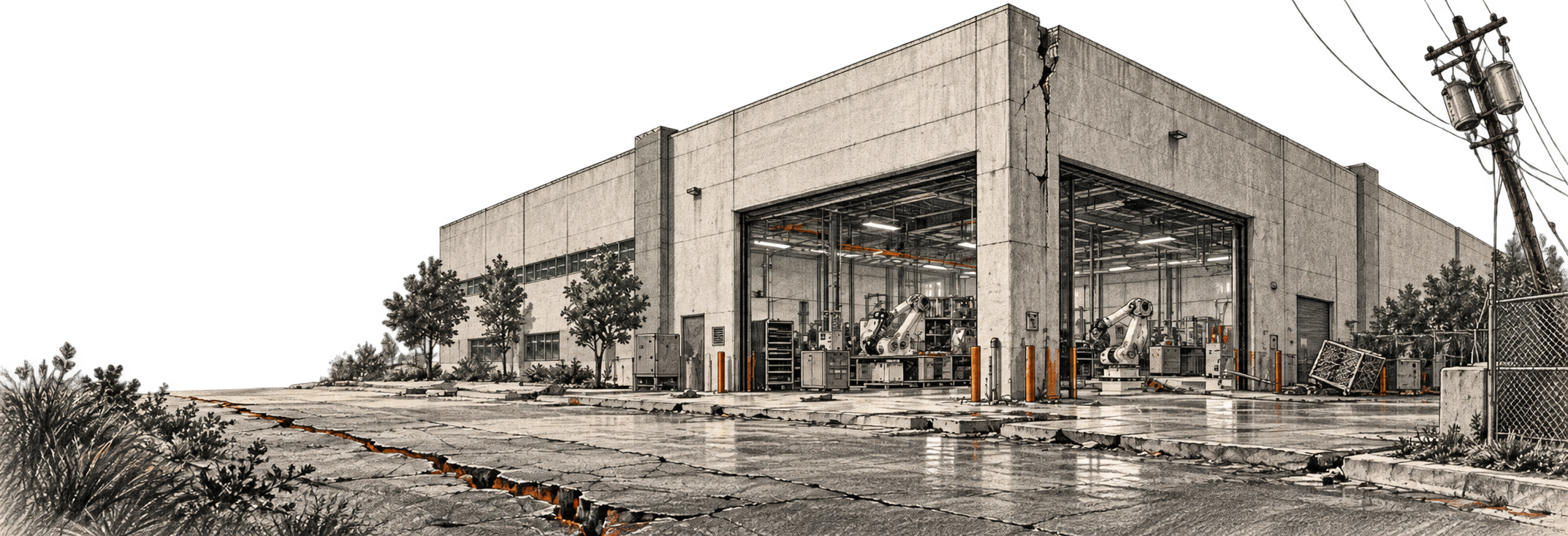
A steel or tilt-up building may remain structurally usable while a machining center shifts, a rack overturns, process piping fails, a control cabinet is damaged, or precision equipment must be inspected and recalibrated.
For hard tech, there are at least three meanings of “safe”: safe for life, safe to occupy, and safe to produce. The third threshold may be the hardest to reach. A facility can therefore enter what this analysis calls the : physically recoverable real estate with commercially meaningful production unavailable.
Consider a hypothetical precision-aerospace plant in the South Bay. The shaking stops. Employees evacuate. Engineers inspect the structure. There is no collapse, no dramatic façade failure, no image likely to lead an evening broadcast.
Inside, the operational story can be very different. A machining cell has tripped. Fixtures require verification. A coordinate-measuring machine must be checked. Sensitive equipment may require re-leveling. Work in process may need reinspection. A sprinkler leak can contaminate production space. None of these conditions requires a visibly destroyed building. Any one can stop a shipment.
For a conventional warehouse, a modest disturbance may be inconvenient. For an operation producing tight-tolerance aerospace components, optical systems, microelectronics or flight hardware, whether a machine remains upright is not enough. The relevant question is whether it can still produce output that passes inspection.
Slab movement · equipment misalignment · calibration loss · process-pipe failure · unstable power · environmental-control loss · contamination · work-in-process rejection · requalification.
Seismic intensity dominates the first minutes of a disaster. Downtime dominates many of the weeks that follow. A manufacturing facility can have several recovery clocks running at once.
exists as a distinct resilience objective because reoccupancy and restored function are not the same. For a mission-sensitive manufacturer, even “basic function” may not be sufficient: qualified production may require stable power, cooling, vacuum, specialty gases, clean environments, calibrated metrology and approved processes.
A building might recover on Day 5 while production recovers on Day 60 or Day 90. The gap is where inspection cost, labor inefficiency, lost throughput, expediting, replacement lead times and business interruption accumulate.
describes liquefaction as the failure of loose, water-saturated sediment during strong shaking as pore-water pressure rises. State hazard zones identify areas requiring investigation; they do not mean every parcel inside a mapped zone will liquefy in a given event.
Nor does liquefaction “start” at one universal earthquake magnitude or PGA. Triggering depends on the intensity and duration of shaking, soil resistance, groundwater and site-specific conditions. But once permanent ground deformation occurs, the industrial chain can be direct: soil strength falls, settlement or lateral spreading develops, foundations or slabs move, buried services deform, machinery loses its reference plane, inspection begins, production stops.
A warehouse may tolerate a condition that a metrology lab, optical operation or precision machining cell cannot. The geotechnical question therefore becomes an economic one: how much differential movement can the process tolerate before the facility is functionally offline?
The failure can occur miles away. A water transmission line breaks. A substation trips. Telecommunications fail. A bridge or freeway closure delays employees and service technicians. A specialty processor on the other side of the basin goes offline.
For advanced manufacturing, “power restored” may itself be too crude a metric. Production may require stable voltage, phase quality, process cooling and supporting controls. Backup generation may sustain safety systems while leaving major production equipment unavailable.
The historic USGS was built as a regional planning exercise, not a prediction. Its economic results are striking because they force earthquake analysis beyond the damaged structure.
The scenario’s economic work estimated , , plus . Business interruption alone was roughly 60% of modeled property damage.
The broader scenario modeled approximately . It attributed roughly in property and business-interruption losses to fire and approximately in BI to water outages.
The lesson is not that those exact totals describe the next earthquake. It is that the loss pathways are connected: shaking triggers physical damage; infrastructure and fire can multiply it; downtime carries it into the economy.
Industrial earthquake loss can compound rapidly. Shaking damages electrical systems, gas lines, batteries, flammable-liquid systems or process equipment. At the same time, sprinklers, water pressure, road access and emergency-response capacity can be impaired.
For hard-tech occupancies, the aftermath can extend beyond burned equipment: smoke contamination, suppression-water damage, chemical cleanup, environmental investigation, replacement lead times and process requalification can convert a recoverable seismic event into something approaching an economic total loss.
The economically critical node in a defense or aerospace supply chain is not necessarily the company occupying the largest property. A specialty heat-treatment shop, plating operation, nondestructive-testing lab, optical coater or precision machine shop can occupy comparatively modest real estate and still sit on a production path with few substitutes.
If such a node is unavailable for 90 days, its direct property damage may be small compared with a large prime contractor’s campus. The downstream schedule effect may not be. That is mission-interruption risk: the consequence of losing the production function, not merely the building.
This is also where apparent portfolio diversification can fail. Ten addresses can share one fault footprint, one liquefaction corridor, one power network, one water system, one freeway or one specialty supplier. To the insurer they are separate policies. To the catastrophe they can behave like one network.
Regional earthquakes produce another form of correlation: demand surge. Structural engineers, inspectors, electricians, sprinkler contractors, machine technicians, calibration specialists, switchgear and replacement equipment are all demanded simultaneously.
A facility’s restart time therefore cannot always be modeled independently from every other damaged facility. A machine that could ordinarily be inspected in three days may wait weeks if the OEM’s regional service queue is overwhelmed. A transformer available in normal conditions may become a long-lead item after hundreds of simultaneous failures.
The severe tail is built from combinations: strong shaking plus shallow groundwater, fragile equipment, prolonged utility interruption, limited repair capacity and a supplier outage. The individual components may each be manageable. Their correlation is what turns them into catastrophe.
Eventually the physical event reaches the capital structure. The tenant loses revenue while continuing to absorb payroll, rent, debt service and other fixed costs. Insurance may cover part of the loss, but deductibles, waiting periods, sublimits and claim-adjustment timelines affect liquidity.
The landlord then faces repair capital, tenant-credit deterioration and rent interruption. The lender sees weaker NOI and potentially lower debt-service coverage. The insurer sees multiple claims. The reinsurer sees regional accumulation.
By this point, the amount of concrete that cracked may no longer be the best measure of severity. The more decision-useful metric may be days until qualified production resumes—and how many other companies depend on that date.
For hard-tech real estate, seismic diligence should not stop after asking whether the structure is adequate. It should ask what shaking the equipment can tolerate; whether critical machinery is anchored; whether slab movement can interrupt production; how long inspection and recalibration take; what power quality the process needs; how long operations can tolerate utility outages; whether critical tools are duplicated; which machines have long replacement lead times; and whether suppliers with few substitutes sit in the same hazard footprint.
Those questions convert seismic engineering into operational underwriting. They also expose why a conventional structural PML can miss the asset that matters most: the production system inside the building.
14 · BOTTOM LINE
Sunday’s M3.2 earthquake came and went without reported major damage. But above and around Southern California’s faults sits an industrial system whose vulnerability cannot be understood by counting buildings likely to collapse. The defining image after a consequential earthquake may be an apparently intact factory—lights on, employees inside, machines idle, shipments stopped.
Mission-Ready · Full intelligence report
Email Carl for a detailed seismic and actuarial intelligence report covering industrial properties and hard-tech and deep-tech tenants—drawing on terabytes of source-traceable property, hazard, infrastructure and operating data.
Scope and deliverables are tailored to the portfolio or site. Strategic intelligence for diligence and planning; not a site-specific engineering opinion or actuarial certification.
Deep trace source ledger